
Overview
The tool I used is called RPFM, a modding tool specifically made for Total War games. It’s best suited for modifying the game’s database; tweaking stats, changing abilities, or creating entirely new ones.
Despite having put many hours into Total War: Warhammer 3, only a small number of them had been spent on the Skaven, one of the most beloved races in the game. To address the frustrations I’d run into during those playthroughs, I created a mod aimed at making the Skaven army a little less fragile, giving its characters more distinct individual power, and making the core Skaven mechanics more engaging. After playing through a full campaign with it, I found it not only functional but, somewhat to my own surprise, nearly well balanced.
General Process
To break down the process a little: this was the first mod I had ever made for any game, and it involved a lot of research into how best to approach it. Beyond that, it required diving into and trying to understand how many of the underlying systems actually worked, what each table and column meant. Which is no small task in a large-scale strategy game like Total War: Warhammer 3. The approach I found most success with was carefully thinking through which table might hold the change I wanted to make, and what it might be named, before going looking for it in the files. When that wasn’t enough, I turned to Steam blogs, Reddit and Stack Overflow. They rarely gave direct answers and instead required a fair amount of interpretation and adaptation to be of any use.
Pillars
I identified three key aspects of the Skaven I wanted to emphasize.
- The Vermintide: The Skaven are known for their massive numbers — waves upon waves flooding the battlefield, with casualties meaning little to their leaders. Their infantry is the flimsiest in the game, as it should be. The issue is that every army has a unit cap of 20, which means a Skaven force will almost always struggle against another full-sized army without a reinforcing stack nearby. Economically manageable for the Skaven, but logistically frustrating for the player.
- The Great Names: The Skaven have some of the most interesting characters in Warhammer Fantasy lore, yet because they are ultimately just mortal ratmen, their physical and magical capabilities don’t really hold up against the Greater Daemons, Dragon Riders and Archmages that crowd every corner of the map. From a lore standpoint this makes sense, but it creates a noticeable dissonance in the gameplay.
- Schemes, yes yes: The Skaven are schemers and backstabbers, plotting in the dark and waiting to strike. They have two core mechanics built around this. Firstly, the ability to ambush enemy armies on your turn, which is immensely powerful when used well. And secondly, the ability to construct undercities beneath enemy settlements, a system with real potential but that is a bit outshone by other mechanics in the game and could be more rewarding.
Schemes, yes yes
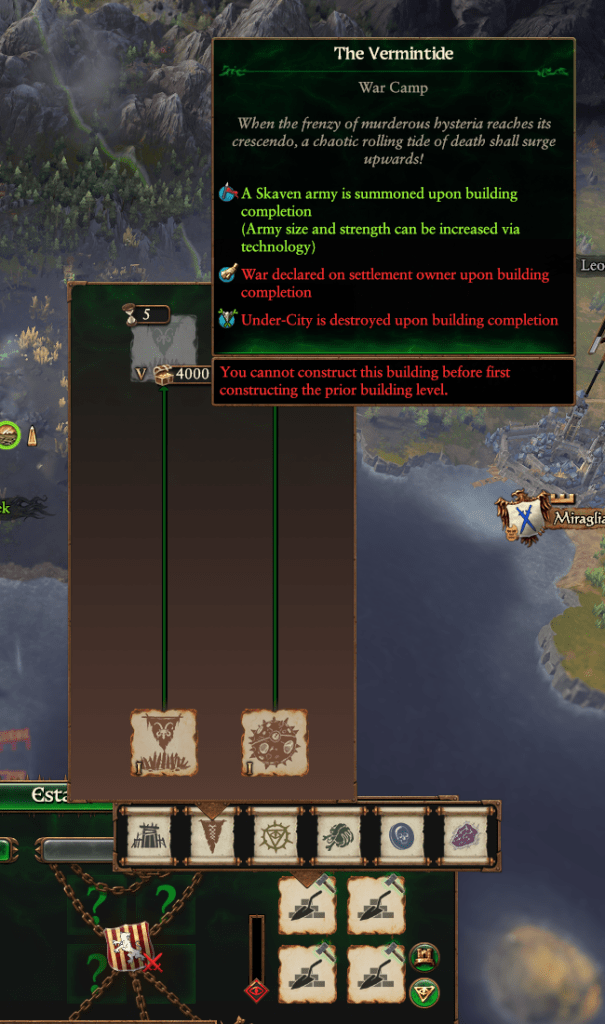
The schemes were by far the easiest aspect to modify. The undercity system has a solid foundation but it had fallen behind the standard of more modern Total War mechanics and didn’t feel particularly rewarding to engage with. One building, for instance, will spawn an army attacking the settlement upon completion, which is a genuinely exciting idea, very in line with the plot of something like Skavenslayer by William King.
In practice though, the build time was too long, the spawned army too weak, and the cost of keeping the building hidden from the settlement’s owner felt punishing. By significantly reducing construction times, lowering the cost of maintaining discoverability and making it easier to establish new undercities while leaving the strength of the spawned armies untouched; I think I arrived at something more useful without tipping it into being overpowered. The spawned forces still couldn’t take a settlement on their own, but they could give the player a meaningful edge as a reinforcing army.
The Great Names
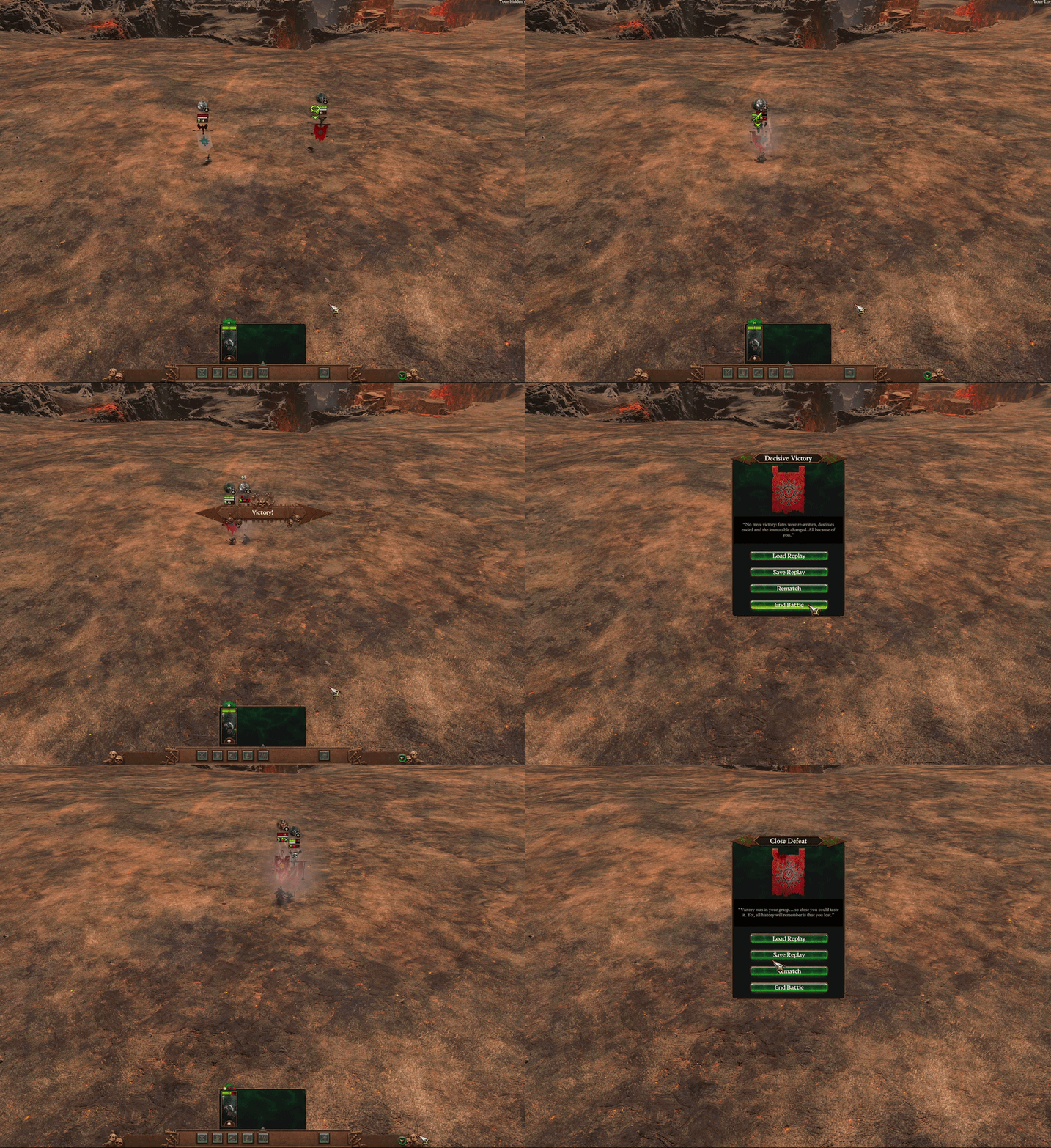
When addressing the individual strength of the legendary Skaven characters, I chose to focus primarily on their melee capabilities. The faction mechanics and skill trees felt solid as they were, and given how powerful magic already is in Total War: Warhammer, I saw no reason to touch that side of things. What mattered most to me was that each character retained their unique identity, so rather than broadly buffing everyone, I leaned into their strengths and in some cases even pushed their weaknesses further. Deathmaster Snikch, chief assassin of Clan Eshin, for example, had his offensive stats and movement speed heavily increased while his defensive stats and health were reduced further. This makes him exceptional at hunting down enemy lords and heroes, but very exposed if he gets surrounded or targeted by other strong fighters.
These changes required a deep dive into the underlying combat systems of Total War, which are considerably more complex than what the game actually surfaces to the player. Within the massive tables storing data on weapons, characters and mounts, there are a huge number of stats that are never shown. Much of the work was therefore a process of reverse-engineering design intent, trying to figure out what the developers had originally built these hidden values to do, before making deliberate changes to them.
The Vermintide
This is the point which I felt the skaven in the base game fell the hardest on and what I worked the hardest trying to address. It is not really a valid strategy, especially in the late game, for the skaven to spam cheap troops. The core of their cheap units like clanrats and skavenslaves are way to weak to be able to do much on their own. Another stronger unit needs to act as a centerpiece, like weapon teams, rat ogres or nightrunners. Thematically, the skaven are supposed to erupt from nowhere in massive numbers. Because of the previously mentioned unit cap for each army this is impossible for the skaven. Other shooting factions solve this by having infantry that can hold the enemy off while their firing lines kill the enemy. But since you need something like three unit of clanrats to equal one unit from another faction the skaven have nothing that can hold the line and instead rely mostly on armies with only shooting, hoping to kill the enemy at range before they arrive at all. To me this simply didn’t feel like the vermintide.
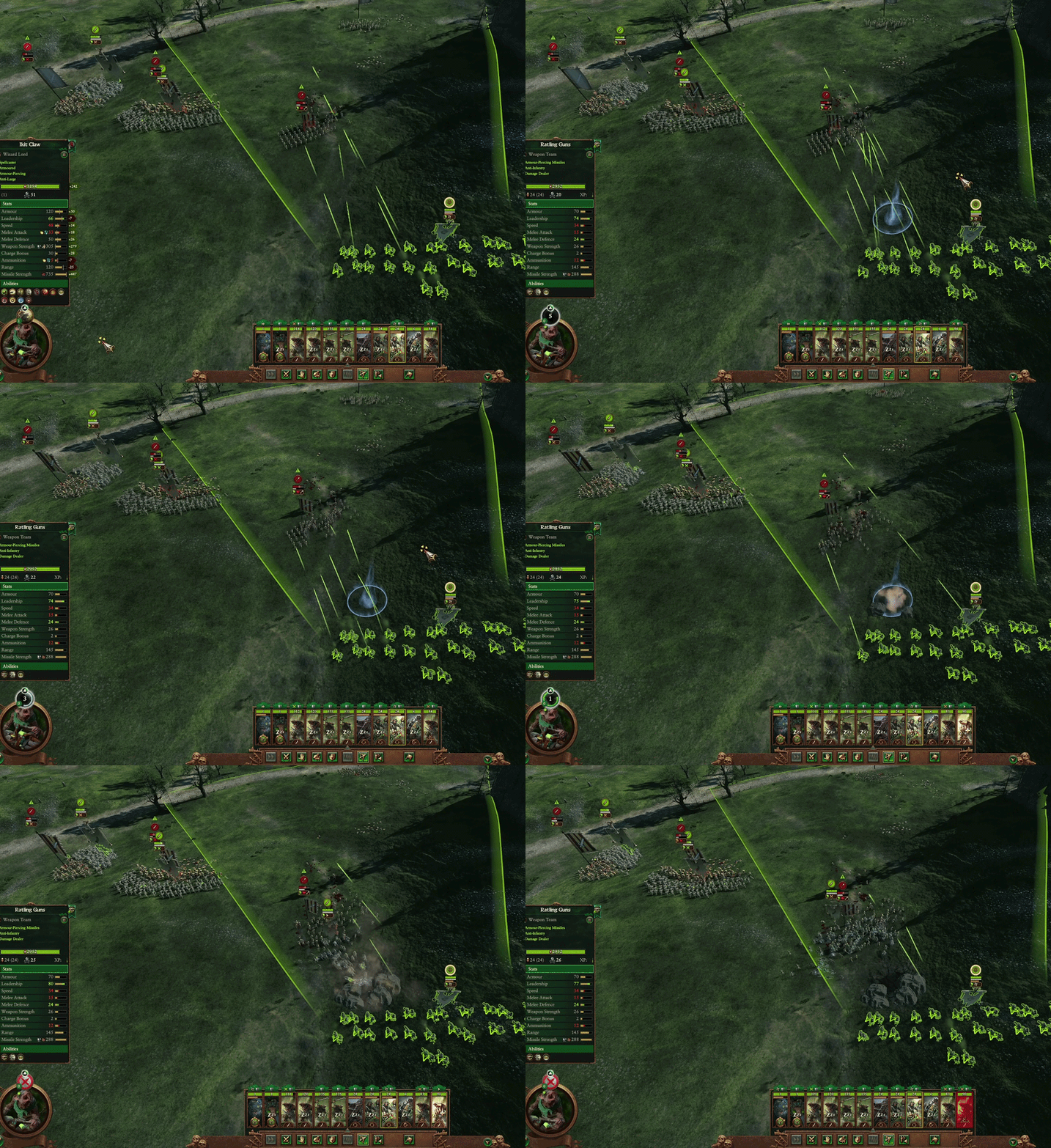
One of the things I did to address this was create a new ability which I gave to each lord and hero as well as the weapon teams. It was built from their normal army ability ‘the menace below’ which summon a unit of clanrats anywhere on the map. The version I created was only supposed to be able to spawn the clanrat unit very close to them. By doing this an army with only weaponteams could still field massive numbers by spawning clanrats. It also turned out not to be as overpowered as might be imagined since the spawn radius was so short, the spawned unit only lasted for a short time and clanrats are themself so inherently weak. The techincal demand to achieve this required creating an entirely new ability and giving it the same effect as the already existing ‘the menace below’ and then giving this new ability to each unit that should have it.
Beyond the ability I also gave the skaven an easier time to replenish lost health after battle in their territory. The skaven are not supposed to care about casualties but given how fickle their infantry is, even at full health, they really could not take fights without being at full health. So, I just let their normal settlement building increase healing so they could recover faster after taking casualties.
Quality of Life
Apart from those targeted changes mentioned above I also implemented some smaller quality of life improvements. For example the unique resource buildings found in some settlements I modified to give some units factions-wide stat boosts, similar to what the warriors of chaos already have. I think this is a really fun mechanic that rewards expanding territory and helps some of the weaker skaven units keep up a little better in the late game.
I did some smaller changes making the food gain, a vital resource to the skaven, slightly easier to get. Food is mostly gained by fighting enemy armies (so you can eat their dead) and used to maintain order and city growth. By reducing the need to continuously fight to maintain food the player can be more methodical about their choices and get more into the planning, scheming mindset I think the skaven should embody.

